
HOME PAGE


|
Tell me and I'll forget. Show me and I'll remember. Involve me and I'll understand - Confucius |
| The whole art of teaching is only the art of awaking the natural curiosity of young minds for the purpose of satisfying it afterwards … Anatole Frances ( 1932, p238) |
 Brain Plasticity: The brain is a muscle. Giving it a harder workout makes you smarter. |
| Summary description ... 3 page (PDF) |
| Detail description (PDF) |
| Reference videos: |
| Reference documents: |
| Future Need's |
| Overview Slides (PDF) |
| Latest Slides 10/2016 |
|
Culture of Thinking: a place in which a group’ s collective, as well as individual, thinking is valued, visible, and actively promoted as part of the regular, day-to-day experience of all group members.
Thinking Skills needs to take a more formal place in the learning process. It should not be hidden away but be a co-equal of each of the core subjects learning.
|
Projects as vehicles for
learning:
from WPI |
|
Space entrepreneur and X PRIZE Founder Peter Diamandis believes that the world today is far too adverse to risk.
True breakthroughs that expand scientific capability take a tremendous amount of adventurous spirit, which means real mavericks need to be audacious in order to discover greatness. |
Core idea:
|
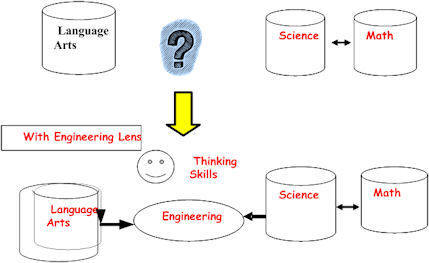
The core idea of our approach is that engineering and thinking skills need not "stand alone" in the curriculum, but can and should leverage existing curricular elements -- in particular literature or social studies/history. We envision a supportive curriculum in which students respond to literature through engineering design projects by identifying needs that the characters have, by identifying multiple possible solutions, and by exploring and refining those solutions through prototyping and revision.
This approach allows the students to tinker with the process. Tinkering is a playful style of design by making constant experiments and exploring new ideas in the design process. It is celebrating the iterative and divergent/ convergent process that is part of the design process.
For example, kindergarteners might respond to a common fairy tale by designing a house for one of the little pigs (or perhaps a means of blowing down a house for the wolf!); fifth graders might respond to the book Island of the Blue Dolphins by identifying needs and solutions for Karana, the marooned main character of the novel. |
| Background: |
|
The process begins with literature, such as fairy tales, starting in the lower grades and leading to more sophisticated stories at older ages – stories that engage students. The teacher facilitate the students finding design challenges while reading and discussing the story. Using the engineering design process & skillful thinking methodology, PreK-5 teachers can create motivating questions that will give students the opportunity to probe, poke and peek into the mysteries of science & mathematics while doing an engineering project as well as learning, through modeling by the teacher, skillful thinking strategies. |
| What we are about |
 |
|
Interdisciplinary Learning
|
Expected outcomes:
Teachers:
Have an understanding of the
roles of engineers and their contribution in society. Use the design process for
creating an intergraded curriculum that shows students the
relevance of all subjects in their daily lives. Understand the
use of thinking skills strategies within their lesson plans. Create life long learners
in their students.
PreK-5 students: When entering the
6th grade, they see learning as an
exciting adventure and the relevance of mathematics, science and
engineering in their lives. Learn to work with 21st. century
skills and be able
to contribute content knowledge required of that activity. Be
comfortable with reflecting on their use of thinking skills in
their lives.
It all centers
around the definitions:
|
|
|
|
It is the policy of EngineeringLens not to discriminate on the basis of race, gender, religion, national origin, color, homelessness, sexual orientation, gender identity, age or disability in its education programs, services, activities, or employment practices.